

Ecommerce PPC Expert
Digital marketing for ecommerce brands that want profitable orders.
Google Ads, Meta Ads, conversion optimization and tracking for online stores, planned as one system and measured against your store’s real revenue. I work as an ecommerce PPC specialist for Shopify and other online stores.
What does an ecommerce marketing consultant do?
An ecommerce marketing consultant plans and runs the paid channels that bring buyers to an online store, mainly Google Ads and Meta Ads, and fixes what stops those visitors from buying: product pages, checkout friction, offers and tracking. The work is judged by profitable orders and store revenue, not clicks or impressions.
Updated October 2026 · By Farrukh Moin Ahmed, digital marketing expert
Sound familiar?
The problems online store owners bring to me most often, and what I do about each one.
The problem
“We spend a lot on ads, but I can't tell what's actually making money.”
Each platform reports its own version of success, and none of them show profit after product costs, shipping and returns.
How I fix it
Measure at store level
Tracking checked against store orders, then reporting that puts total ad spend next to total store revenue, by channel and product line.
The problem
“Google and Meta both claim the same sales.”
A shopper sees an Instagram ad, searches on Google later and buys. Both platforms take the credit, so their reports add up to more than you sold.
How I fix it
Give each channel a clear job
Meta to create demand, Google to capture it, and results read in three layers: platform, store and what changes when spend changes. More in Google Ads vs Meta Ads for ecommerce.
The problem
“Traffic is up, but sales aren't.”
More visitors don’t help if product pages leave questions unanswered or checkout adds friction.
How I fix it
Fix what happens after the click
Product page, offer and checkout improvements through CRO, so every channel converts better at once.
The problem
“Our reports are all clicks and impressions, not orders.”
Platform metrics are easy to report and easy to make look good, but they don’t pay the bills.
How I fix it
Report on orders and revenue
Orders, conversion value, cost per purchase and store revenue, with clicks and impressions only as diagnostics.
The problem
“We've hit a ceiling. Every time we spend more, ROAS falls apart.”
Search demand is finite, and pushing more budget into the same campaigns buys less certain buyers at higher cost.
How I fix it
Scale in the right order
Fund high-intent Google to its ceiling, grow new demand with Meta prospecting and creative, and let rising brand searches lift Google again.
Results from online stores
Named ecommerce clients with documented numbers. Each one has a full case study.
$76,211
Google Ads conversion value · Woda Bags
£218K
Google Ads conversion value · SofaBay
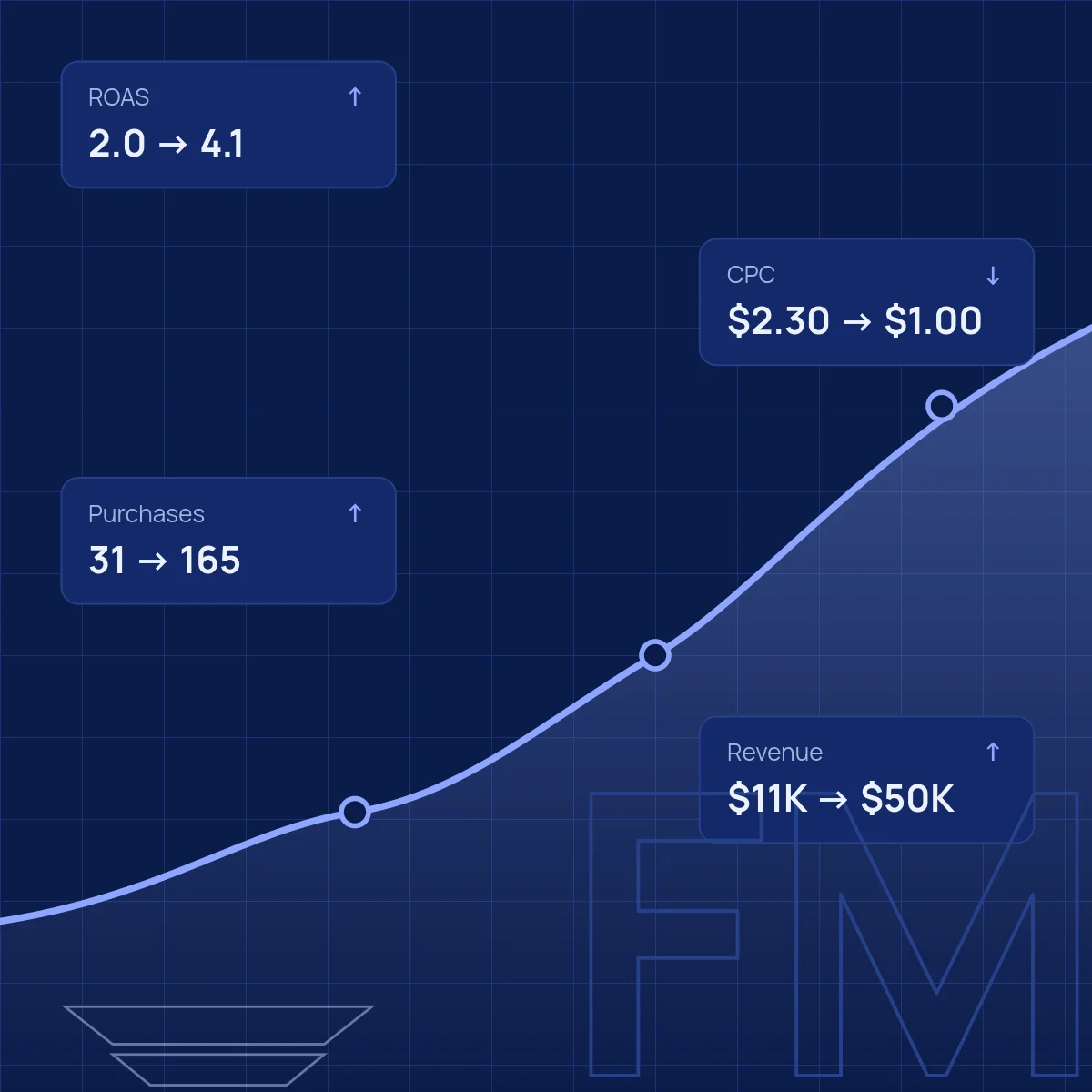
$11K → $50K
Conversion value · Petoi, Oct–Dec
10.01
Meta ROAS · Woda Bags, since late April 2026
Platform-reported results from individual accounts. Periods and full figures are on each case study.
Channels for online stores
Each channel has a different job. The mix depends on how much demand already exists for what you sell.
Google Ads for ecommerce
Shopping, Performance Max and Search to capture people already looking for your products.
Google Ads for ecommerce
Meta Ads for ecommerce
Facebook and Instagram to create demand among people who aren’t searching yet.
Meta Ads for ecommerce
Conversion rate optimization
Product pages, checkout and offers, so more of your paid traffic buys.
CRO services
Analytics & tracking
GA4, Tag Manager and Conversions API, checked against your store’s orders.
Analytics services
Reddit Ads
For products with an engaged community of enthusiasts or researchers.
Reddit Ads services
Which channel does what
Every channel has a different job in an ecommerce account. This is how I decide where budget goes.
| Channel | Its job | Works best when | Main metric |
|---|---|---|---|
| Google Shopping & Performance Max | Show products to people searching for them | People already search for your product types | Conversion value and ROAS by product line |
| Google Search | Capture high-intent searches by product, category or attribute | Searches are specific and commercial | Cost per purchase on non-brand terms |
| Meta Ads | Create demand among people not yet searching | Products are visual, new or need discovering | Purchases and cost per purchase, new vs returning |
| Reddit Ads | Reach engaged communities around a niche | An active community already discusses your category | Assisted sales and cost per qualified visit |
| CRO | Turn more paid visitors into buyers | Traffic is healthy but conversion rate lags | Conversion rate and revenue per visitor |
| Analytics & tracking | Make every number above trustworthy | Always, before scaling spend | Platform purchases reconciled to store orders |
Choose your channel
Each channel has its own guide, with pages for specific kinds of online store underneath.
Google Ads for Ecommerce
Shopping, Performance Max and Search, built on a search-ready feed and judged by store revenue.
Meta Ads for Ecommerce
Facebook and Instagram campaigns structured for purchases, with a creative system and accurate tracking.
Who this is for
An honest filter, so we both save time.
A good fit if
- Your store already sells and you want paid media to scale it profitably
- You can share access to your ads, analytics and order data
- You want decisions based on margins and real revenue
- You’re open to changing account structure, not just bids
Probably not a fit if
- You want a guaranteed ROAS before anyone has seen the account
- You want ads run without access to tracking or sales data
- You’re looking for the cheapest possible management fee
- You want a set-and-forget setup with no testing
From Audit To Scale.
Every engagement follows the same sequence. Nothing scales until the data behind it is trustworthy.
01
Audit
Account, tracking, website, funnel and data analysis.
02
Diagnose
Find where performance is being restricted or spend is being wasted.
03
Strategize
Build a data-driven acquisition and conversion strategy.
04
Optimize
Improve targeting, messaging, campaigns, landing pages and tracking.
05
Scale
Scale what works while maintaining efficiency.
What I report on
Numbers that connect ad spend to money in the bank, not just platform dashboards.
Store revenue and orders
The source of truth. Platform numbers are compared against it, never the other way round.
Blended return (MER)
Total revenue divided by total ad spend across every channel, so double-counted sales can’t flatter results.
Platform ROAS by channel
Google and Meta reported separately, with attribution settings stated.
New vs returning customers
Growth comes from new buyers. Returning customers are tracked separately so they don’t inflate acquisition results.
Cost per purchase vs breakeven
Every campaign is held against the cost per purchase your margins can afford.
Contribution after ad spend
What’s left after product costs and ads: the number that pays the bills.
Ecommerce case studies
Real campaigns, real problems, real results.
Case study 02 · Ecommerce
Woda Bags
Launching Google Ads as a scalable growth channel
8.12
ROAS · 395 orders
Case study 03 · Ecommerce / Furniture
SofaBay
Building Google Ads from scratch and driving scalable growth
23.83
ROAS · £218K conversion value
Case study 01 · Robotics / Ecommerce
Petoi
Teaching the market, not just selling a robot
2.0 → 4.1
ROAS
Case study 04 · Fashion / Ecommerce
Nicolette’s Couture
Fashion ecommerce on Google Ads
913
Conversions · 3.42 ROAS
Questions about ecommerce marketing
Which channel should an online store start with?
It depends on existing demand. If people already search for what you sell, Google Shopping and Search capture them fastest. If your products need discovering, Meta creates that demand. Most stores end up needing both.
What’s a good ROAS for ecommerce?
The one that makes you money. Your breakeven ROAS is 1 divided by your gross margin: at a 40% margin, a 2.5 ROAS covers product costs. Targets should start from your margins, not industry averages.
What’s the difference between ROAS and MER?
ROAS is revenue a single platform attributes to its own ads. MER, or blended return, is your total store revenue divided by total ad spend. Platforms can claim the same sale, so MER is the more honest view of the whole account.
How much should an online store spend on ads?
Enough for each campaign to collect conversion data, and no more than your breakeven cost per purchase allows. I set budgets from your margins and order value, then scale what proves profitable rather than starting from a fixed number.
How long before I see results?
Fixes to tracking and wasted spend usually show first. Bidding systems need conversion data to learn, so new campaigns should be judged over weeks rather than days.
How do you report results across Google and Meta?
Each platform’s figures are reported separately, because both can claim the same order. I compare them with your store’s actual revenue so budgets follow what really sold.
Do you build landing pages or edit the store?
I find what to change and why, with specific recommendations for product pages, checkout and offers. Your developer or store team implements them.
Do you work with stores outside the US?
Yes. Clients include stores in the US and UK, and I work with businesses across Canada, Australia, the UAE, Europe and Pakistan.
Ecommerce articles
Practical guides on running paid acquisition for online stores.
- October 10, 2026
- Ecommerce, Google Ads, Strategy
Google Ads for a new online store: the first 90 days
A 90-day plan to launch Google Ads for a new online store: foundations, feed, Shopping and Performance Max, then...
Read article
Meta Ads campaign structure: one campaign or three? What Woda Bags’ account showed
Woda Bags ran three Meta campaigns for different funnel stages. Consolidating them into one all-funnel campaign cut cost per...
Read article
- October 10, 2026
- Ecommerce, Google Ads, Meta Ads, Paid Media
Google Ads vs Meta Ads for ecommerce: which should you run first?
Google Ads vs Meta Ads for ecommerce, compared: what each channel does, which to start with, how to split...
Read articleTell me about your store
Share what you sell, what you’re spending and what isn’t working. I’ll reply with an honest view of where the opportunity is.
What happens next
- You tell me about your store and what isn’t working
- I look at what I can see: your ads, site and tracking
- I reply personally with an honest view of the opportunity
- If it’s a fit, we agree the scope of an account audit